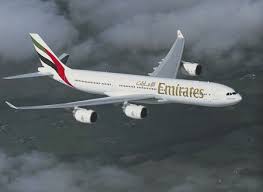
"Emirates is a formidable airline now, with probably the largest model fleet with pretty high standards and very expensive network. They also have a very good hub, which is Dubai," Munir Majid, said on the sidelines of an economic forum.
He said Malaysian Airlines can compete with the Dubai icon by offering better product quality, more competitive rates and bigger fleet of aircrafts. But doing so is also tough because Emirates has been equally aggressive on those aspects.
Majid said Malaysian Airlines' balance sheet had not been strong enough to invest in more aircrafts, like what other Middle East airlines did, hence it was "left out by the competition".
The airline, however, has undergone an intensive balance sheet restructuring and is now set to capture a bigger market share.
"We are now in expansion mode," Majid said. "It is difficult but I think we have some competitive advantages in terms of product offering. We've had financial problems but we are coming back and we will compete."
Despite the financial difficulties, the company is not looking at new rights issues. "If we want to raise funds, we will issue rights. We have we had two rights issues done in the last five years...we have enough. We have repaired our balance sheet and we're on the go," Majid added.
The company slipped into the red in its second quarter, recording a net loss of MYR535 million ($173 million) due mainly to derivative losses from its fuel hedges. Its second quarter result shows its operating loss narrowed to MYR285.6 million from MYR425.6 million a year ago.
During its second quarter, revenue grow 26 per cent to MYR3.2 billion as passenger revenue increased 22 per cent to MYR 2.3 billion, driven by stronger load factors and higher capacity.
For first half, the company made a net loss of MYR225 million due to mark-to-market losses, compared to a net profit of MYR180 million in the previous corresponding period. However, it was able to book operating profit of MYR4 million in the six months ended June instead of the operating loss of MYR567 million a year ago.
The late delivery of A380 planes is another reason why the airline failed to compete neck-to-neck with other airlines from emerging markets, Majid said.
Malaysian Airlines has been in discussions with Airbus on its six on-order A380s, with the first one due in 2007, before being delayed to January 2011 and then to the third quarter of 2011. The delivery was pushed back to the second quarter of 2012 earlier this year.
"They were supposed to be delivered in 2007 then it has been postponed twice and now we're looking at 2012. By the time it comes in, it may not be able to compete as effectively. This is a serious loss for us," he said.
The airline said in December that it had been awarded MYR330 million in compensation from Airbus for earlier delays. "Compensation is one thing," Majid said. "We can get the cash obviously but you are talking competition here. Without those product offering, we've been left behind by other airlines."
Majid said the airlines has 35 planes on order. "In terms of payment, our policy has changed we are now going to own one-third, lease one-third and the other one-third is flexible where are will be looking at the market in terms of libor interest rates. We are not going to own 100 per cent like we used to up till about the end of last year."
The company is also looking at boosting code sharing deals, similar to the cooperation deal it signed with Oman Air in June. The pact, which is slated to bolster revenue by more than MYR 26 million annually, enables its passengers to fly nonstop from Kuala Lumpur to Muscat and book connecting flights to Amman and Kuwait City on Oman Air, as well as have more flight options to Dubai and Beirut.
Oman Air passengers in return, can book connecting flights on Malaysia Airlines to six new destinations namely Singapore, Hong Kong and the Malaysian cities of Langkawi, Kota Kinabalu, Penang and Kuching.
"We are looking at more cooperation, which will mutually benefits like code sharing arrangements and or alliance," Majid said. "We are not a member of any alliance. Emirates is also not a member of any alliance. There are various ways to approach the competition in a very difficult industry."
The company is optimistic its performance will be positive influenced by that the world's recovering economy. Given encouraging signs in both passenger and cargo traffic growth, the International Air Transport Association (IATA) recently revised its forecasts for the second time this year. It now expects airlines to post a global profit of $2.5 billion in 2010, a major improvement compared to its previous $2.8 billion loss forecast released in March.
-------------------------------
Read more Aviation News http://www.zawya.com/
View Model Aircraft

No comments:
Post a Comment